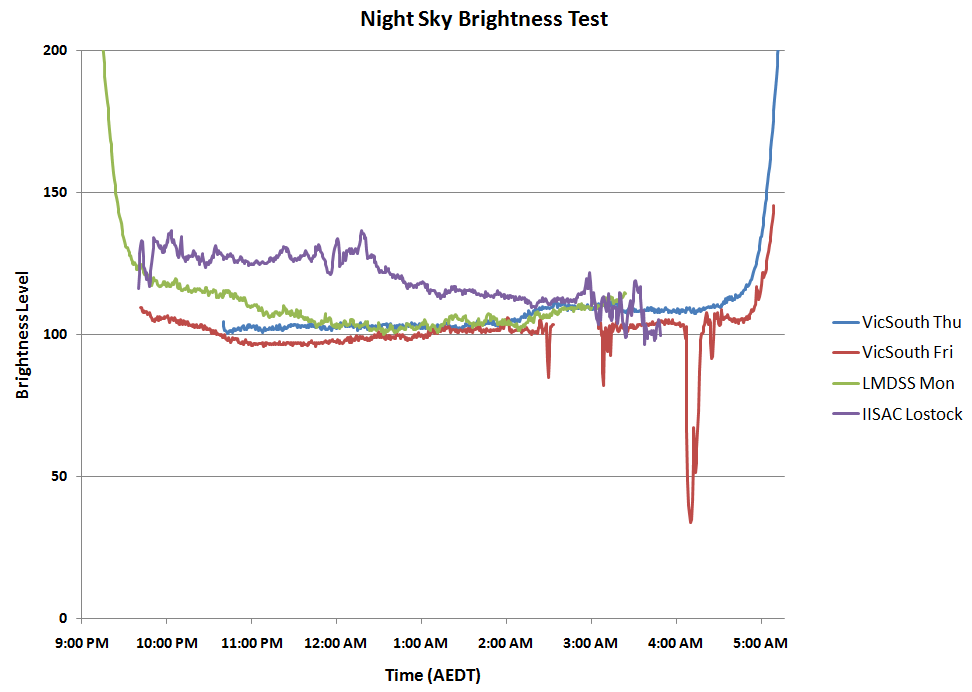
Having taken my astrophotography to a new level in the last couple of years (courtesy of having had a real job in the UK for five years), and now having returned to Oz last year, I entered a bunch of my astro-images to the fourth annual David Malin astrophotography awards, hosted by the Central West Astronomical Society in Parkes, NSW.
Over breakfast on Friday 29th June, I was fortunate enough to hear Christof Ruehl (Group Chief Economist, BP plc) present the BP Statistical Review of World Energy 2007 in Melbourne. This is not intended as a complete summary of the presentation, since the slides and full speech notes are available from the BP Website.
MEDIA RELEASE: TUESDAY 29th MAY 2007
Everybody is feeling a little short changed when it comes to petrol prices.
But Phil Hart, from the Australian Association for the Study of Peak Oil, is not upset with the price at the pump. Instead, he is wound up by the economists and their explanation that high prices are the fault of refineries in the United States. While there is a grain of truth to that argument, the US has for a long time required imports to make up for a shortfall in refining capacity.
To meet insatiable demand, Asian refineries are crying out for oil but producers in the Middle East can't keep up, Hart says. “Crude oil production is lower than at any time in the previous two years so somebody has to lose out. We are amongst the winners because, so far, consumers have been prepared to pay the price”.

The Association for the Study of Peak Oil in Melbourne is hosting the opening night of a new, award winning peak oil movie:
Book Now at www.cinemanova.com.au or Phone 03 9349 5201.
Tickets $20, $18 Concession
Includes glass of wine on arrival
Join Kenneth Davidson (The Age Senior Economics Journalist), Phil Hart (that's me!) and Elliot Fishman (Institue for Sensible Transport) in a panel discussion following the film on the phenomenon of Peak Oil.
You can also download and distribute a PDF for this event.

To the great surprise of those who were sure climate change was our biggest problem, John Howard has said that our greatest moral challenge is, like those of proud generations before us, "to build a prosperous, secure and fair Australia".
If Howard's English is not your first language, here's a translation:
"Stuff the environment. Let the rich get richer and make damn sure everyone is busy being terrified by something else."
An 'Age' reader provided another useful intepretation:
"Let's borrow more and more so that we can consume more and more and have the economy grow more and more and to hell with the greenhouse gases. Sounds like a pretty good moral challenge to me."
John McCredie, Toorak (The Age, Wednesday 25th April 2007)
All those folks who think I should get a real job can go jump.
I'm famous now.. two articles in 'The Age' in the space of five days.
Read all about it:
Oil Companies Running Hard to Stand Still:
The Age, Business Section back page, Friday 16th March 2007.
Esso/BHP could put carbon under sea:
The Age, Business Section, Tuesday 20th March 2007.
Following a summary of EIA data for 2006, I thought I would make a more detailed country-by-country estimate of the potential for 2007. Starting with the headline EIA figures for last year:
Crude Oil and Condensate: 73.5 Mb/d (down 0.2)
Natural Gas Liquids (NGLs): 7.9 Mb/d (up 0.14)
Other Liquids: 3.3 Mb/d (up 0.08)
Total Liquids: 84.6 Mb/d (up an insignificant 0.02)
Mb/d = million barrels per day
kb/d = thousand barrels per day
Oil prices set new records and the industry maintained a historically high level of activity in 2006. Energy agencies issued consensus forecasts that production would rise. Yet crude oil production was down and total liquids production was flat. The economists should be shaking in their boots.